 Countdown128days
2027.3.24-3.27 Shenzhen World Exhibition & Convention Center
The Hotter the Optical Module, the Harder the 0.4 mm Housing
【Introduction】 From die casting to CNC precision machining — the manufacturing chain behind a few-millimeter optical module housing
The faster AI computing runs, the hotter optical modules get — and the harder the few-millimeter metal housing wrapped around them becomes to make. A 0.4 mm cover and a 0.6 mm base face three challenges: die-cast forming, multi-face precision control, and batch-to-batch consistency. This article breaks down how Huaxinda, Yuanjia, Jiaye Precision, and Bilian Machinery tackle optical module housing manufacturing, and points you to ITES 2027 to compare full-chain precision manufacturing capability.
Summary
AI computing is pushing optical modules from 400G toward 800G and 1.6T, raising both data rate and port density and pushing the thermal load all the way down to the optical module housing. Locked by strict switch interface standards, this small metal structure cannot change its size — so the gains must come from die-cast forming, multi-face precision control, and batch consistency. This article breaks down the three manufacturing challenges and how Huaxinda, Yuanjia, Jiaye Precision, and Bilian Machinery cover mold development, alloy die casting, CNC precision machining, and precision inspection, pointing to the 2027 ITES Shenzhen Industrial Exhibition.
Facing ever-higher thermal requirements, optical module makers have recently delivered a range of new answers.
Crealights connected its 1.6T OSFP224-IHS silicon-photonics module to a switch for live interoperation. The module integrates metal fins on top, so internal heat travels through the housing to the fins, then is carried away by the equipment’s airflow.
REALSEA’s 800G liquid-cooled module uses a flat-top housing that contacts the system-side cold plate, transferring heat to the host-side cooling system.
Going further into high density, cold plates and inlet/outlet liquid structures are starting to be built inside the pluggable module itself. Eoptolink’s highest 12.8T XPO sample and HG Genuine’s 12.8T XPO ultra-high-density pluggable liquid-cooled module both make the liquid-cooling structure a native part of the module.
The three routes differ, but they change the same thing — the few-millimeter metal shell wrapped around the optical module.
The IHS approach requires it to form an effective heat-conducting structure with the heat sink; the RHS approach requires a flat, stable external contact surface; the XPO approach requires a reliable mounting and protection structure for the internal cold plate and liquid-path components.
Why, then, does a few-millimeter metal housing carry such demanding thermal requirements?
Key Takeaways
As LLM training and inference scale up, optical modules move from 400G to 800G and 1.6T, raising both data rate and port density and pulling the thermal burden into the module and the switch. The optical module housing becomes the bridge between the internal heat source and the external cooling system, so its thermal requirements keep climbing.
Why Stronger AI Computing Makes Optical Modules Hotter
As large-model training and inference continue to expand, AI data centers need to deploy more GPU servers. A large number of GPUs working together means more frequent data exchange, which raises the bar for network bandwidth and transmission speed.
To keep up with computing growth, data-center switches and optical modules are constantly upgrading. As the key device connecting servers to switches and switches to switches, optical modules are moving from 400G toward 800G and even 1.6T, with rising deployment density and expanding scale.
Goldman Sachs estimates the global optical module market will reach about US$67.7 billion, US$131.4 billion, and US$148.5 billion in 2026, 2027, and 2028 respectively, with global shipments of 548 million, 691 million, and 729 million units.
But higher data rates and denser ports also pull a growing thermal burden into the module and the switch.
Look first at a single optical module. To support higher-rate transmission, internal component integration keeps rising, while the module’s form factor stays relatively limited — the space left for heat transfer and dissipation has not grown accordingly.
Now look at the switch as a whole. As a single device carries more and more high-speed modules, the heat from each module stacks up into the system’s thermal load.
A single module gets hotter, and multiple modules working together make the switch even hotter. With data rate and port density rising together, cooling becomes a challenge that both the module and the system must face.
The optical module housing is the “bridge” connecting the module’s internal heat source to the external cooling system.
Heat generated by the chip and other internal components travels along an internal thermal path to the housing, then spreads outward through the housing to the switch’s cage, heat sink, and other structures, and is finally carried away by air or liquid cooling. The better its thermal conductivity, the more easily heat moves outward.
The optical module housing’s form factor is strictly limited by the switch’s standard interface, yet its thermal requirements keep rising.
With size hard to break through and performance impossible to compromise, the only room left is in the manufacturing process.
The precision-manufacturing contest plays out within these few millimeters.
Key Takeaways
The housing’s size is locked by the switch standard interface, so the only room is in the process. A CETC No.8 Research Institute patent puts the housing cover at just 0.4–0.55 mm. Die-cast forming, multi-face precision control, and batch consistency — three hard problems — test the whole chain, from Huaxinda and Yuanjia to Jiaye Precision and Bilian Machinery.
When the Size Is Locked, What Can the Housing Do?
An optical module housing looks like just a small metal structure, but actually machining it is far more than shaping metal into a given form.
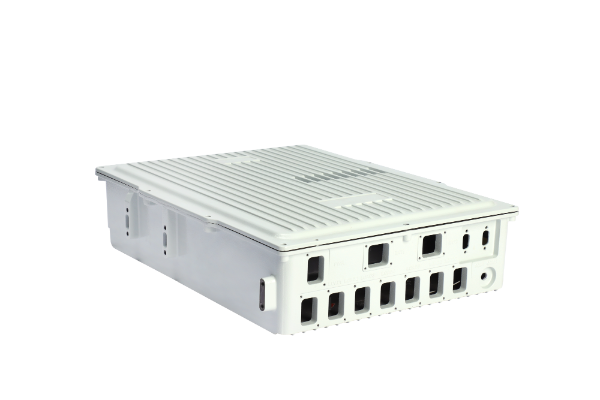
Take a CETC No.8 Research Institute patent as an example: its zinc-alloy die-casting solution produces a cover just 0.4–0.55 mm thick and a base 0.6–0.8 mm thick.
A housing this thin tests not only one machining step but the hard capability of the entire manufacturing chain.
Around these manufacturing pain points, ITES gathers many companies deeply rooted in precision manufacturing, covering mold development, alloy die casting, CNC precision machining, and precision inspection — demonstrating multi-step capability from metal forming to precision machining.
Thin Walls Make Die-Cast Forming Hard
Die casting is a key process for some optical module metal housings. But during production, castings can develop internal defects such as porosity and shrinkage. These problems not only hurt product quality but may surface in later CNC machining, causing rework or even scrap.
Huaxinda focuses on coordinating die-cast forming quality with downstream machining. It runs 160T to 3500T die-casting machines, large CNC machining centers, and X-ray flaw detection plus direct-reading spark spectrometers — covering mold design and fabrication, metal forming, downstream precision machining, and quality inspection for die-cast housings.

Image source: Huaxinda
Yuanjia focuses on coordinating precision mold development, alloy die casting, and downstream machining. It mainly designs and manufactures precision molds and produces zinc, aluminum, and magnesium alloy die-cast parts and CNC-machined parts.

Image source: Yuanjia
Its business spans precision molds, alloy die casting, and CNC machining — matching the multi-step manufacturing needs of metal housings from forming to precision machining.
Complex, Compact Structures Make Precision Control Hard
The housing’s multi-step cavities, locating holes, mounting slots, and mating faces must all be machined within limited space. Multiple clamping steps easily introduce position errors, so reducing the number of clamping steps and controlling the relative positions of different machined faces is a key challenge in complex-part machining.
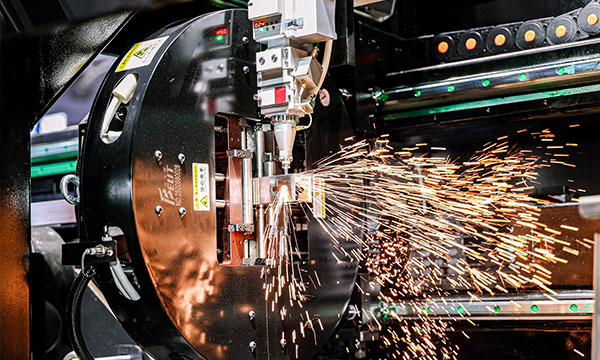
Jiaye Precision focuses on precision control for complex structures and multi-face machining. Specializing in precision component manufacturing, it runs more than 400 automated production machines, including five-axis linked machining centers, 3+2 five-axis machining centers, five-axis CNC lathes, and wire-cut EDM machines — core CNC machining capability for optical module housings.

Image source: Jiaye Precision
It is also equipped with scanning CMMs and profile projectors for precision inspection, and has in-house capability to design and build fixtures and dedicated automation equipment.
Many Steps Make Batch Consistency Hard
In the past, a housing was a standard part machined to drawing — meet the dimensions and it shipped. Now it changes with the cooling design, so buyers want more than a quote and a delivery date. They want to know whether the supplier can co-design the structure, keep up with design changes, and take responsibility for how the part performs once installed.
Bilian Machinery focuses on precision part machining and full-process quality control. Specializing in precision component machining and non-standard automation design, it runs about 80 CNC machines and about 30 precision inspection machines, with incoming, in-process, and final inspection quality control — keeping automated production consistent.

Image source: Bilian Machinery
Keeping orders and costs under control through continuous design changes depends on close collaboration between upstream and downstream players — which is why ITES keeps focusing on the precision-manufacturing equipment and parts-manufacturing supply chain.
Key Takeaways
A few-millimeter housing tests a precision manufacturer’s ability to refine details, stabilize quality, and deliver continuously. What companies need is not a single machine but an understanding of which process route fits which scenario, plus practical production know-how to compare different equipment and technical solutions.
A Few-Millimeter Housing Rests on a Whole Supply Chain
AI computing upgrades happen on chips and servers, and are now extending to precision metal components. A few-millimeter optical module housing tests a precision manufacturer’s ability to refine details, stabilize quality, and deliver continuously.
What companies need is not just one machining machine — they also need to understand the suitable scenarios for different process routes, the practical solutions used in real production, and how to compare different equipment and technical approaches.
Only by combining equipment, process, and real production needs can manufacturing problems truly be solved.
About ITES Shenzhen Industrial Exhibition

From March 24 to 27, 2027, the 28th ITES Shenzhen Industrial Exhibition will be held at the Shenzhen World Exhibition & Convention Center (Bao’an). The Precision Manufacturing Equipment & Parts Manufacturing Show gathers 200+ outstanding precision manufacturers, presenting the full-chain core elements of precision component manufacturing — from source R&D and design, manufacturing, and surface treatment to contract manufacturing — along with conferences and forums on multi-station machining of complex surfaces, brittle and hard material processing, additive manufacturing, and quality inspection, helping the supply chain collaborate upstream and downstream.
Action Guide
Buyers: Come to ITES Shenzhen Industrial Exhibition on March 24–27, 2027 (Shenzhen World Exhibition & Convention Center, Bao’an), and compare full-chain suppliers for optical module housings — mold development, alloy die casting, CNC precision machining, and precision inspection — at the Precision Manufacturing Equipment & Parts Manufacturing Show. Exhibitors: Exhibit your verifiable thin-wall die casting, multi-face precision machining, and batch-consistency control solutions, and lock in precision structural part orders from the optical module and computing hardware sectors.
FAQ
Q1: Why are optical module housings getting harder to make?
As optical modules move from 400G to 800G and 1.6T, internal integration keeps rising, but the housing’s form factor is strictly limited by the switch standard interface and cannot change — so gains must come from die-cast forming, precision control, and batch consistency.
Q2: What makes a 0.4 mm thin-wall housing hard to machine?
Thin-wall die-cast parts easily develop internal defects like porosity and shrinkage; multi-step cavities, locating holes, and mounting slots must be machined on multiple faces within limited space; multiple clamping steps easily introduce position errors; and volume production must hold consistency — all of which test the entire manufacturing chain.
Q3: Where can I compare precision-manufacturing solutions for optical module housings?
The Precision Manufacturing Equipment & Parts Manufacturing Show at ITES 2027 (March 24–27, Shenzhen World Exhibition & Convention Center, Bao’an) gathers 200+ precision manufacturers covering mold development, alloy die casting, CNC precision machining, and precision inspection.
Entity Glossary
Crealights, REALSEA, Eoptolink, HG Genuine, CETC No.8 Research Institute, Goldman Sachs, Huaxinda, Yuanjia, Jiaye Precision, Bilian Machinery, ITES Shenzhen Industrial Exhibition
Key Data at a Glance
Goldman Sachs: global optical module market at about US$67.7 / 131.4 / 148.5 billion in 2026–2028, with shipments of 548 / 691 / 729 million units
CETC No.8 Research Institute patent: zinc-alloy die-cast optical module housing with a 0.4–0.55 mm cover and a 0.6–0.8 mm base
Huaxinda: 160T to 3500T die-casting machines, large CNC machining centers, X-ray flaw detection
Jiaye Precision: 400+ automated production machines, incl. five-axis linked machining centers and 3+2 five-axis centers
Bilian Machinery: about 80 CNC machines and about 30 precision inspection machines
ITES 2027: March 24–27, Shenzhen World Exhibition & Convention Center (Bao’an), Precision Manufacturing Equipment & Parts Manufacturing Show with 200+ companies
-END-
#ITES #PrecisionManufacturing #OpticalModule #DieCasting #PrecisionMachining