 Countdown155days
2027.3.24-3.27 Shenzhen World Exhibition & Convention Center
Countdown155days
2027.3.24-3.27 Shenzhen World Exhibition & Convention CenterAs AI computing power keeps stacking up, heat dissipation is being pushed to a new breaking point.
【Introduction】 As AI liquid cooling scales, competition shifts to the closed-loop motion control system.
TrendForce's latest forecast sees global AI server shipments growing nearly 31% year over year in 2026, while the penetration rate of liquid cooling in AI chips will rise from about 33% in 2025 to 53% in 2026.
As the new generation of AI platforms enters production ramp-up, liquid cooling is moving from early validation to orders and delivery. Cold plates, quick disconnects, manifolds, distributors — components that once revolved around prototypes and small-batch validation — are now facing much larger delivery volumes.
But being able to make a sample does not mean mass production will run.
When a part goes from a few hundred or a few thousand pieces to hundreds of thousands or millions, manufacturing is facing a completely different problem.
More noteworthy is that this round of change ultimately tests more than just the machine tool.
CNC systems, servo drives, encoders, linear scales — the core technologies hidden inside the equipment — are being pushed to the fore by liquid cooling mass production.
Key Takeaways
• Liquid cooling is entering volume ramp-up: penetration in AI chips rises from about 33% in 2025 to 53% in 2026 as global AI server shipments grow nearly 31%.
• Mass production changes the game: what matters is not making one good part, but staying fast, stable, and consistent across hundreds of thousands of parts.
• The machine body isn't enough — the real competition lies in the closed loop beneath: CNC (compute) → servo/drive (execute) → encoder/linear scale (feedback) → correction.
• AI is now entering this loop for tool-wear judgment and anomaly prediction, adding a “prediction layer” on top of the existing nervous system.
Parts Are Only the Surface, Manufacturing Cares More About System Capability
Once liquid cooling ramps up, the first thing to change is the manufacturing logic.
Take the liquid cooling quick disconnect: the part is small, yet it often concentrates multiple precision operations — outer diameters, inner holes, threads, and sealing surfaces — each demanding dimensional accuracy, surface quality, and sealing reliability. Making a single qualified part is not that hard. What truly separates players is whether the equipment can shorten cycle time, keep dimensions stable, and maintain quality as tools wear — across tens of thousands or hundreds of thousands of continuous parts.
For the cold plate, the machining difficulty is another story entirely.
Some high-performance cold plates involve complex flow channels, bores, and sealing structures that require tight dimensional and positional accuracy while also fighting burrs, deformation, and surface quality issues. These machining errors ultimately propagate downstream, affecting flow resistance, heat exchange, and sealing performance. So once cold plates enter mass production, what is harder than “machining accuracy” is stable machining accuracy.

In a customer case disclosed by Weihong, monthly AI cold-plate output has reached 800,000 pieces with a 99.7% yield. At that scale, making a single part well no longer means much. How tool paths are optimized, how non-cutting time is shortened, and how accuracy is maintained over long runs — any small change in any link, multiplied across hundreds of thousands of parts, becomes real capacity and real cost.
Liquid cooling is amplifying not just component demand but the gap in manufacturing capability. What customers now care more about is: “How many can you make in a day? Can it stay accurate over continuous runs? Can hundreds of thousands of parts stay identical?”
Once the question reaches this point, competition naturally moves beyond the machine body itself.
For Stable Liquid Cooling Mass Production, What Do Machine Tools Rely On?
Recently, subtle changes have been unfolding across the supply chain. With the explosive rise of the AI liquid cooling track, mainstream Japanese Swiss-type lathes that once had lead times of just 3–4 months are now generally booked into 2027, with some models seeing ordering cycles of over 12–16 months. This huge capacity vacuum is prompting many machine tool builders and end customers to reconsider domestic systems. But to absorb this wave of orders, the machine body alone is far from enough.
A machine tool that is fast, accurate, and consistently accurate never relies on a single component. Simply put: the CNC system handles “how to compute and how to move”; the servo and drive turn commands into real motion; and the encoders and linear scales tell the system “where it actually is.” Compute, execute, and feed back in a continuous loop — that is what forms a complete motion-control closed loop.
Once liquid cooling enters mass production, any weak link in this loop gets continuously magnified.
CNC Systems: First, Get the Machining “Figured Out”
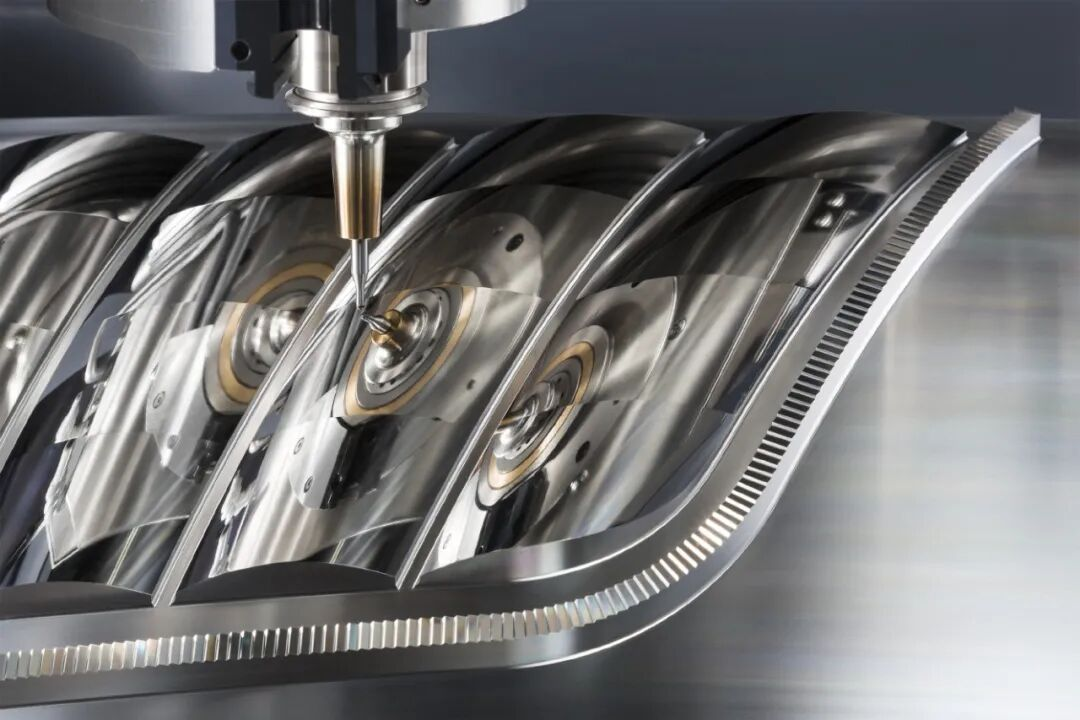
For the micro-channels, sealing surfaces, and hole positions of cold plates, as well as the complex spatial structures in distributors and manifolds, a machine tool must perform not just simple linear and arc motions but more complex multi-axis simultaneous motion, tool-path control, and error compensation.
The CNC system therefore determines “how” the machine tool machines: whether 5-axis simultaneous motion holds trajectory accuracy, whether tool posture stays stable on complex surfaces, and whether tool paths can shorten idle travel and cutting time without sacrificing precision. High speed and precision, multi-axis simultaneous motion, path optimization, and error compensation are thus the directions in which high-end CNC systems keep strengthening.
For example, Huazhong's HNC-10 intelligent CNC system integrates AI large models and AI computing power to support intelligent programming and process optimization, intelligent accuracy improvement (geometric/thermal error compensation), and intelligent operation and maintenance — all directly tied to whether complex liquid cooling structures can be machined stably.
Syntec targets the pain points of liquid cooling connector mass production head-on with a one-stop Swiss-type lathe and mill-turn lathe solution — from preset tool-path templates to temperature-rise adaptive compensation, ready out of the box for rapid, stable mass production. The Swiss-type lathe solution is built on Syntec's 220TB PLUS dual-channel, dual-spindle system, completing all operations in a single setup to eliminate the cumulative errors of re-fixturing. Combined with inverter-integrated drives, built-in motorized spindles, and hollow magnetic-ring motors, it delivers both rigidity and responsiveness, covering about 80% of mainstream liquid cooling connector models.

Image source: Syntec
Weihong's NK300CX PLUS, meanwhile, carries a full set of liquid-cooling-specific machining algorithms: adaptive velocity smoothing plus position feed-forward compensation enables stable, jitter-free feed when milling ultra-fine 0.1 mm narrow slots, leaving flow-channel sidewalls free of steps and burrs and greatly reducing downstream deburring. It offers three machining modes — precision-priority, precision-efficiency balance, and speed-priority — to break the mass-production bottleneck from the underlying motion control, fitting the full range of AI liquid cooling parts.

Image source: Weihong
Other players — Siemens, GSK, LNC, KND, Lynuc, Fagor, and Chaotongbu — are likewise strengthening their capabilities around high speed and precision, 5-axis simultaneous motion, error compensation, and intelligent machining.
Servo Drives: Not Just Computing the Motion, but Achieving It
The CNC system plans the motion trajectory; it is the servo and drive that actually execute it. During batch machining of liquid cooling parts, the equipment continuously performs positioning, acceleration/deceleration, direction changes, and multi-axis coordination. The faster the cycle, the higher the demands on dynamic response, synchronization, vibration control, and repeat positioning.
To help machine tools shed heat-induced degradation and vibration distortion over weeks of high-intensity operation, Chaotongbu's AC servo drives come with rich control-function modules that realize various machine control functions. The standard control interface connects easily with domestic and international CNC systems, letting their capabilities be fully leveraged, and can be widely applied to drive mill-turn machines, vertical machining centers, CNC lathes, and more.
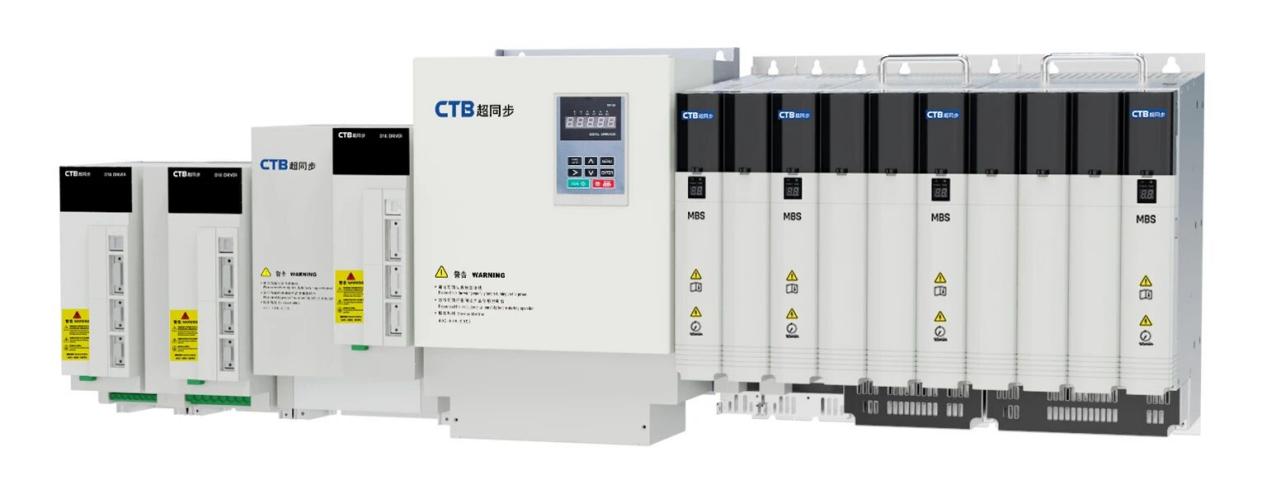
Image source: Chaotongbu
ZONCH has launched its Z8000 series high-performance closed-loop vector frequency converters (premium model). Supporting closed-loop vector control with extremely fast dynamic response, they react quickly to load changes for rock-solid spindle speed stability, and offer stronger overload and overvoltage suppression. They suit the spindles of high-end CNC machines and precision machining centers that demand the highest speed-control accuracy and dynamic response.
Other brands — Fuji Electric, Inovance, INVT, Jingyan Motor, Huada Motor, Zhongyou Intelligent Control, Xinli Electric, Gete Motor, Mige Motor, Baigela, and Chaodechuang — are also pressing ahead in servo, drive, and motion control. The one core pain point they all solve: complete the same tool path in less time, and repeat the same motion hundreds of thousands of times while still fitting perfectly.
Sensing & Feedback: How Does the Machine Know If It's “Still Accurate”?
A control system issuing the right command does not mean the equipment's actual position is perfectly correct.
Once machining reaches the micron level, the mechanical structure alone can hardly guarantee the equipment stays in its original state after long runs. Feedback elements must close the loop: encoders capture rotational position and speed, while linear scales provide high-precision feedback on linear motion position.
For example, Reagle Sensing's KIH series hollow inductive-grating high-precision encoders, showcased at ITES 2026, maintain absolute accuracy of ≤±5 arc-seconds even under harsh oil and water conditions, with dynamic latency under 25 μs, helping 5-axis machines and multitasking machining centers break through performance bottlenecks. Xinnuo Grating's NC600 absolute linear scale, meanwhile, offers system error of ≤±2 μm and multiple interface protocols.

Image source: Reagle Sensing
For parts like cold plates that demand high dimensional and positional accuracy, the value of such feedback elements is not just “measuring more accurately” but helping the equipment stay continuously aware of its own state during uninterrupted machining.
In this field, companies such as Fagor, Givi, Reagle, Beixin Optoelectronics, Aidike, Hangtian Jiudou, Demochuan, Aierge, Langmin Optoelectronics, and Buruite all provide different products and solutions for position feedback. What they are all essentially doing is the same thing: moving machine tools toward sense–feedback–optimize, and turning smart manufacturing from a concept into reality.
At this point, the machine tool's underlying logic is clear: CNC system computes → servo drive executes → encoder/linear scale feeds back → system corrects. And now AI is entering this loop. AI can also read the massive machining data, judge tool wear, and predict anomalies — in effect adding a layer of “prediction” on top of the original nervous system. For liquid cooling components, this shift is especially important.
Final Thoughts
So looking back at this liquid cooling boom, what it brings to the machine tool industry is not just a sudden surge of hot parts like cold plates, quick disconnects, and manifolds. What is really changing is that the new industry is redefining what a “good machine” means.

Image source: Chaotongbu
In the past, the question was mostly how accurate a machine could be. In scale manufacturing, you also have to ask whether it can run fast, run stably, and keep replicating the same accuracy.
Beyond AI servers, new industries such as humanoid robots, high-end medical devices, and consumer electronics are also bringing more complex parts, higher precision requirements, and greater scale-manufacturing demand.
Manufacturing competition will keep moving down this same path.
That is precisely why the Precision Manufacturing Equipment Core Technology Show, part of ITES 2027, will present CNC systems, control and drive systems, sensing and connection technologies, FA and transmission technologies, PCBA processing services and components — the key process technologies and solutions behind precision manufacturing equipment. By driving deep integration of machine tool core technologies with equipment manufacturing, it aims to present exactly this underlying logic and empower the high-quality development of the precision manufacturing equipment industry.As orders from new industries enter the mass-production stage, what is being revalued may not be just one type of equipment,
but the entire set of underlying capabilities that support China's precision manufacturing in moving toward the high end. Understanding how these core technologies underpin high-precision, high-consistency, high-reliability manufacturing capability may well be the first step to seizing this wave of opportunity.